
In our last post, we walked through what an Ideal Customer Profile (ICP) is, how to build one for B2B and B2C businesses, and where many companies go wrong in the exercise. If you haven’t read that one yet, I’d encourage you to start there.
But defining your ICP is only the first step in developing a marketing strategy. The next question is just as critical, and it’s one that many companies spend very little time on:
Do your offerings actually meet the needs of the customers you’ve identified as ideal?
It’s a question that sounds obvious, but the answer is rarely as clean as we’d like it to be. Many companies assume that because they have a strong, feature-rich product or service, it naturally aligns with what their target customers care about. In practice, that alignment requires deliberate analysis and iteration with all your go-to-market teams.
In this post, I’ll walk through how to test whether your offering’s attributes match your ICP’s needs, how to score that alignment, and what to do with the results.
Start by Understanding What Your ICP Actually Needs
Before we can evaluate whether an offering (meaning your product or service) fits, we need to be clear on what the ICP actually cares about. This goes beyond the general pain points we defined in the ICP exercise. Here, we’re getting specific about the functional, operational, and emotional needs that drive purchasing decisions for either consumers or businesses.
The best way to get this clarity is direct: talk to your target customers. Conduct interviews, run surveys, listen to sales call recordings, and review customer feedback. Ask questions like:
What are the biggest challenges in your day-to-day operations?
When you evaluate a solution like ours, what criteria matter most?
What would make you switch from your current provider?
What does a successful outcome look like for you?
Pair these conversations with the segmentation factors from your ICP definition: demographics, firmographics, technographics, behavioral characteristics, and readiness indicators. Different ICP segments may prioritize different needs. A $2M electronic component manufacturer and a $15M healthcare software company might both be ideal customers, but the specific needs that drive their purchasing decisions can look very different.
The goal is to build a clear, prioritized list of what your ICP needs from an offering like yours, grounded in evidence rather than assumption.
Define Your Offering’s Attributes
With your ICP’s needs defined, the next step is to catalog the attributes of your offering.
An attribute is any individual component of your product or service that is designed to benefit the customer and enhance their experience. Attributes can be physical features, design elements, operational capabilities, service functions, delivery methods, support structures, pricing models, or anything else that makes up “the package” that contributes to the value a customer receives.
For example, a B2B software platform might have attributes like real-time reporting dashboards, API integrations with third-party tools, dedicated onboarding support, a self-service knowledge base, and tiered pricing based on usage. A professional services firm might list attributes like a proprietary methodology, a named account lead, quarterly business reviews, and guaranteed response times.
A few important notes to consider about this exercise:
Attributes can belong to a single offering or reflect a bundled offering. If you sell a suite of products or a combined product-and-service package, market the attributes across the full bundle as the customer experiences it.
Be comprehensive. List everything your offering includes, even the attributes that you aren’t sure make as much of an impact. The scoring exercise that follows will separate what matters from what doesn’t.
Never assume that every attribute is essential. This is a critical mindset shift. We naturally want to believe that everything we’ve built has value (and it might). But the question isn’t whether an attribute has value in the abstract. It also isn’t about pride in engineering or design. The key question is whether your ICP cares about it enough to influence a purchasing decision.
Score Your Attributes Against ICP Needs
This is where the exercise becomes actionable. Take the list of ICP needs and the list of offering attributes, and build a simple scoring model that measures how well each attribute addresses what your ICP cares about.
Here’s how I walk clients through this:
Create a matrix with your offering’s attributes listed down the left column and your ICP’s prioritized needs across the top. Then score each attribute on a scale of 1–5 based on how directly and effectively it addresses each need. For example:
5 = This attribute directly solves a top-priority ICP need.
4 = Strong alignment with a meaningful ICP need.
3 = Moderate alignment, contributes to value but isn’t a primary driver.
2 = Weak alignment, tangentially related at best.
1 = No meaningful connection to ICP needs.
The great thing about this approach is that you can adjust it however you would like. You can use a scale of to 1–10, or perhaps a weighted model if certain customer needs are significantly more important than others. The key is consistency: score every attribute honestly, using customer feedback and behavioral evidence rather than internal enthusiasm as the guide.
If the scoring model is thoughtful and executed well, patterns emerge quickly. Some attributes will cluster at the top, clearly aligned with what your ICP values most. Others will land in the middle or at the bottom, revealing gaps between what you’ve built and what your target customers prioritize.
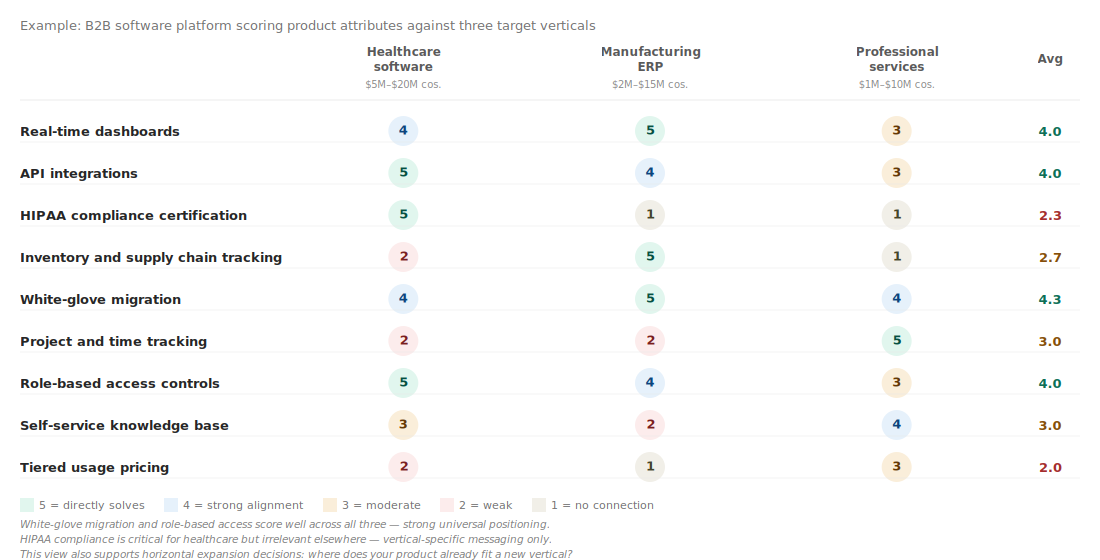
Representative Example for B2B:
Here’s an example of what a scoring model might look like for a B2B process improvement software that sells to three different end customer segments. Notice the differentiated scores specific to each segment, and how they drive differences in the overall feature scoring.
Representative Example for B2C:
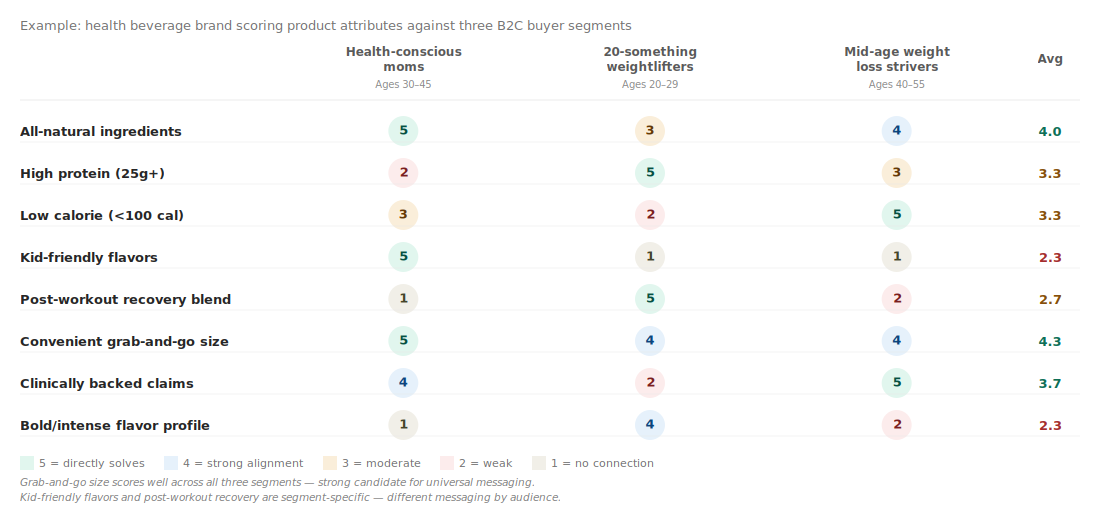
Here’s an example of how a scoring model might work for a new health beverage that targets segments with very different needs: health-conscious moms, 20-something weightlifters, and middle aged individuals trying to lose weight. In this example, the feature attributes are valued quite differently by each segment.
Focus Your Messaging on What Scores High
The attributes that score highest against ICP needs are the ones that should be at the center of your messaging. These are the product features or service elements that your target customers care about most, and they should be front and center in your positioning, marketing campaigns, and sales conversations.
This is where many companies struggle, because the exercise requires time and discipline. When you’ve invested time and resources into building a product or service, it’s natural to want to talk about everything it does. And for internal audiences, that comprehensive view has value. But for your ICP, the message needs to be focused on the attributes that solve their specific problems.
Here’s how I phrase it to my clients: don’t fall in love with everything your product does, even if it really is a great product. Your ICP doesn’t care about everything. They care about the things that make their life better, and your messaging should reflect that priority.
What to Do When Overall Scores Are Low
Not every attribute will score well, and that’s expected. The more important question is what to do about it. When your scoring model reveals that key ICP needs aren’t being met by your current offering, you have several strategic paths to consider:
Invest in R&D to strengthen the offering. If there’s a clear gap between what your ICP needs and what your offering delivers across its list of attributes, product development or service enhancement may be the right move. This is especially true when the gap is in a high-priority need and closing it would meaningfully improve your competitive position.
Launch a new offering to meet the need. Sometimes the gap is too large to close through incremental improvements. In those cases, a new product or service line may be warranted. Consider building this internally or bringing it in through a partnership.
Consider a different ICP. If the offering consistently scores low against a particular customer segment’s needs, it may be a signal that the segment isn’t the right fit, even if the customer’s profile looked promising. Revisiting your ICP definition with this new data can redirect your efforts toward customers who genuinely value what you offer.
Retire offerings that don’t meet any needs. This is the hardest decision, but sometimes the right one. If an offering scores low across the board and no ICP segment values it, continuing to invest in it drains resources from higher-impact areas. If you go this route, make sure you have something to come behind it so you’re not leaving a gap in your portfolio.
Consider Production, Distribution, and Expansion
Scoring well against ICP needs is essential, but it’s not the full picture. Even if your ICP values an offering highly, you need to confirm that you can produce and distribute it at the scale required to meet expected demand. A product that your target customers love but that you can’t reliably deliver creates different problems: unmet expectations and damaged trust.
This same scoring model also supports expansion decisions. When an offering scores strongly against one ICP segment, it’s worth evaluating whether additional segments might value it as well. This is horizontal expansion: taking a proven offering and applying it to a new target customer group. The scoring model gives you a structured way to test that hypothesis before committing resources.
In both cases, the scoring model becomes a decision-making tool that connects product strategy, marketing strategy, and operational planning. The companies that use it consistently make better bets on where to invest and where to pull back.
The Bottom Line
Understanding your ICP is foundational. But the next step, testing whether your offerings actually meet that ICP’s needs, is what turns strategy into action.
A simple scoring model can reveal where your offering is strong, where it falls short, and where your messaging should focus. It can guide product development decisions, expansion strategies, and honest conversations about what to prioritize and what to let go.
The companies that do this exercise well don’t just market more effectively. They build better products, allocate resources more efficiently, and create stronger alignment between what they sell and what their customers actually value.
At Four Cross Advisory, we help companies build and run these scoring models as part of a broader go-to-market strategy. If you’re ready to pressure-test whether your offerings truly align with your ICP’s needs, we’d welcome the conversation. Schedule a call here.